Law, Crime & Social Order
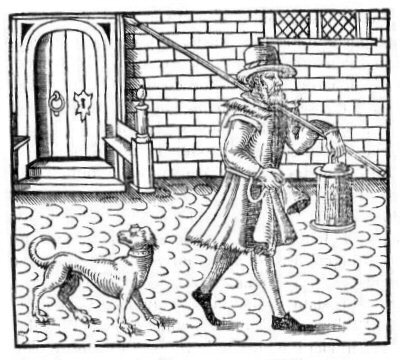
Early Modern Watchman
A man patrolling the streets with the help of a dog. These individuals, not part of a formal police force, served to catch criminals and create an atmosphere of safety and order.
Introduction
Written by L.K.
In early modern England, rape was seen as a social crime, one that focused on the effects these acts had on society, such as how others saw rape victims with less respect and contempt. After a community learned about a crime of rape having been committed against a victim, who could have been a woman, the latter often lost her reputation. Kupor mentions that for women not to lose their families’ and husbands’ honour, they did not bring up such sexual details in how they were treated after being raped. The social standings of rapists in some instances made it harder for victims to receive justice, as these men had a good reputation with the people around them, leading to the judge not declaring guilt. Fears surrounding low-class attributes, such as poverty, were exacerbated by the growing unlawful occupation of prostitution. Concerns about immorality increased during the times of economic hardship during the Nine Years' War, which made women turn to selling their bodies just to make money. As they were believed to have been partaking in sexual sins, they were taken to institutions where they were trained out of their ways through inhumane discipline to fit the traditional masculine vision of how women should live and work. Individuals, who were more often than not men, and groups desired control over women’s bodies and took control of the narrative about the latter’s sexual experiences.
Throughout time and culture, ideas of what was considered to be morally and/or legally right in terms of expressions of sexuality have changed. Oftentimes, especially in Western European societies, this is derived from religious values. In early modern England, law and morals derived from Christianity. At this time, women were under more scrutiny due to their biological predisposition and were caught in the middle of issues surrounding sex, especially extramarital, infidelity, and general lewdness. Due to the close-knit nature of English villages and towns, people would keep others in line to ensure they did not breach these moral, religious, and legal laws concerning lewdness. In “Trial of woman (t16770117-2)” of the Old Bailey Proceedings Online, a middle-aged woman is found guilty of killing her baby, whom she gave birth to out of wedlock, and in “Trial of married woman (t16770711-1)”, a woman is found guilty of engaging in bestiality with a dog after being reported by witnesses spying on her. I explore the question: Were women more likely to be found guilty of crimes relating to sex in comparison to their male counterparts? Were men more likely to get away if they did the same? How did laws favour males? I believe that it is essential for people to find out whether or not moral and legal interpretations of Christianity regarding sexuality in a specific period of England were used to keep women subservient to and below men.
Trial of married woman
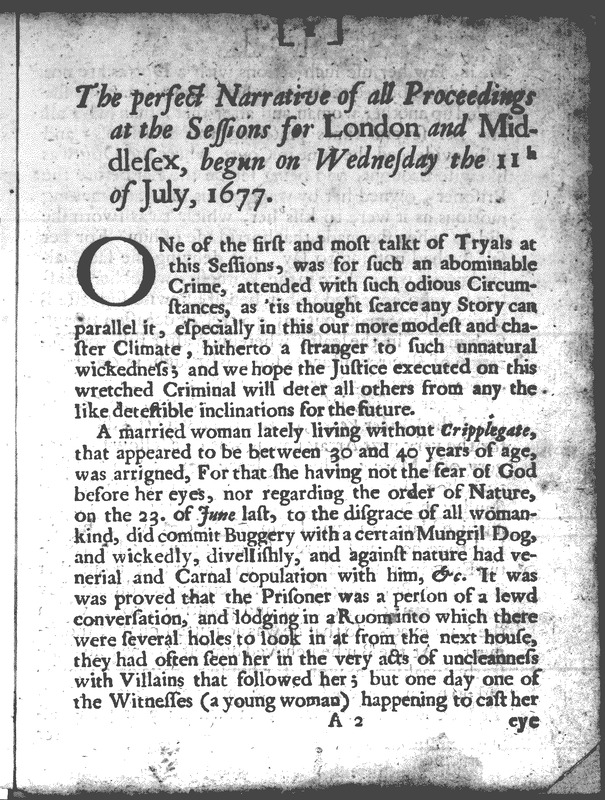
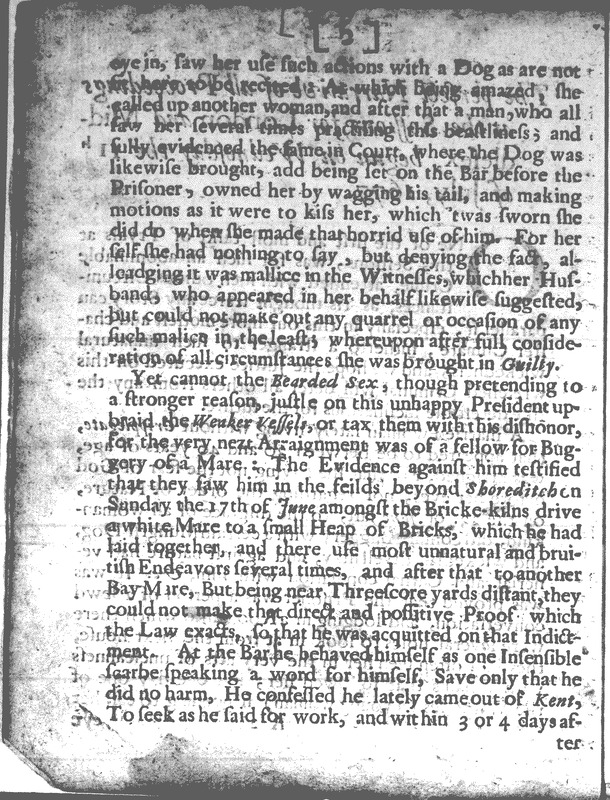
In this primary source, dating back to July 1677, a woman who was aged between 30 and 40 years committed a crime that was considered extremely vile at the time, with no other cases matching such an act. She committed bestiality with a dog on multiple instances, which was witnessed by a few different people who looked through holes into the property. The judge ordered the dog to be brought into court for trial with the woman and its affectionate behaviour towards her was used as evidence. The woman accused of these acts said nothing, except to deny the claims, arguing that they were just lies by witnesses. At the time, it seems as though the general populace constantly surveilled others as a way to ensure there was no sexual or moral rule-breaking, and if there were, these acts were reported to the authorities.
Trial of woman
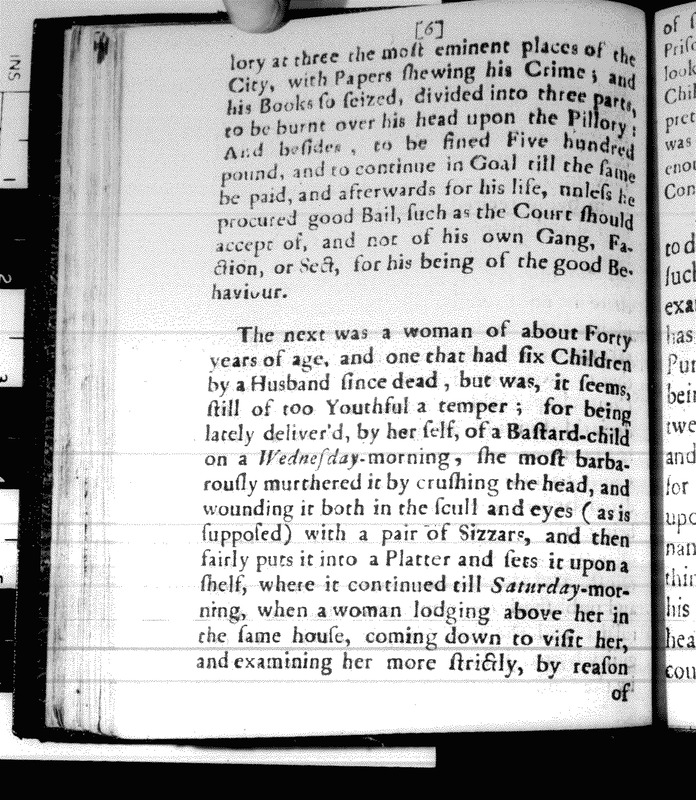
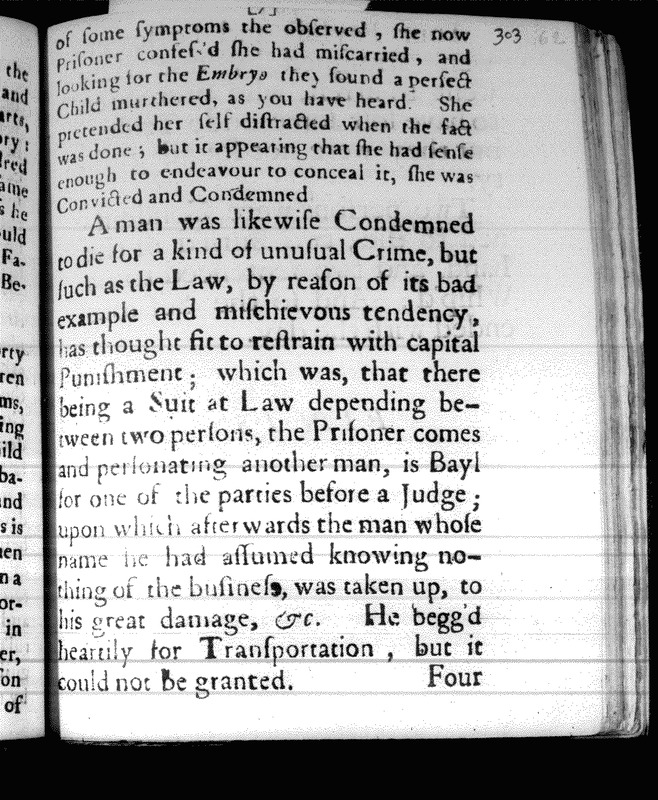
In this primary source, dating back to January 1677, a woman who was approximately 40 years old, widowed, gave birth to a child out of wedlock, killed it and was found guilty. Another woman who lived above her checked on the mother due to noticing odd behaviour exhibited by the latter, soon discovering the corpse. The murderer claimed that she had a miscarriage, but visible wounds to the body show evidence of head injury to the skull and eyes. This trial account can help show that women who had kids outside of marriage faced shame, exclusion and condemnation from the people around them, an example of community discipling. There is no sign that the man who impregnated the woman was also brought into the court, showing that sexual regression laws seemed to favour males more than females.
Bibliography
Kupor, Alexa. "Desire as Violation: Sexual Violence as a Social Crime in Early Modern English Court Records and Literature." Embodied: The Stanford Undergraduate Journal of Feminist, Gender, and Sexuality Studies 2, no. 1 (2023).
Old Bailey Proceedings Online (www.oldbaileyonline.org, version 9.0). “Trial of married woman (t16770711-1).” Accessed January 30, 2026, at https://www.oldbaileyonline.org/record/t16770711-1?text=lewd.
Old Bailey Proceedings Online (www.oldbaileyonline.org, version 9.0). “Trial of woman (t16770117-2).” Accessed January 30, 2026, at https://www.oldbaileyonline.org/record/t16770117-2?text=bastard.
Smith, Jaylyn Denee. “Unlawful Employment: The Sex Trade In Early Modern England.” ProQuest Dissertations & Theses, 2025.
Thomas, Jac Morfydd. "Analysing Expectations Around Sexual Agency for Women in England during the long Eighteenth Century." PhD diss., York St John University, 2023.
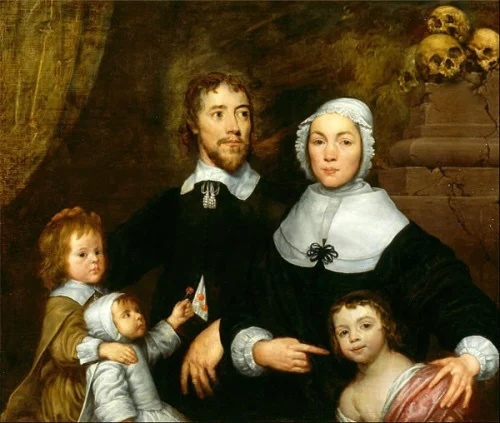
In Early Modern England, the household was a central part of everyday life, and women were expected to play a key role in managing it. Domestic responsibilities such as cooking, cleaning, childcare, and even basic medical care were considered essential duties of women. These responsibilities were not only necessary for the functioning of the household but also reflected broader social expectations about gender roles, family structure, and social order during this time.
The image displayed here, a seventeenth-century family portrait, visually represents these ideas. The woman is shown surrounded by her children, emphasizing her role as a caregiver and central figure within the household. Her calm and composed appearance reflects the ideal of a well-managed home, such as cleaning, cooking, and caregiving. While the presence of multiple children highlights expectations of motherhood and responsibility. This image presents a structured and orderly family life, which aligns with how society believed households should function.
A key written source that supports this interpretation is The English Housewife (1615) by Gervase Markham. This instructional manual provides detailed guidance on how women should manage a household, including preparing food, preserving supplies, caring for animals, and making remedies for illness. The level of detail in this source shows that women were expected to have a wide range of knowledge and practical skills in order to successfully run a household. It also demonstrates how important domestic work was to both the family and the wider community.
However, both the image and Markham’s text represent idealized versions of domestic life rather than the full reality. The painting depicts a calm, orderly household, while the manual describes how women should behave. Since Markham was a male author, his work reflects societal expectations rather than women’s lived experiences. Similarly, the image also presents a carefully arranged and controlled version of family life, likely representing a wealthier household. This means that it may not reflect the realities of all women, especially those from lower social classes who may have faced different challenges and responsibilities.
To better understand everyday life and women's social order, it is useful to compare these sources with others. For example, The Diary of Samuel Pepys offers insight into daily experiences and shows that life could vary depending on social class and circumstances. Historians such as Keith Wrightson and Robert Tittler also explain how social structure, economic conditions, and cultural expectations shaped everyday life in Early Modern England. Their work highlights that while certain ideals existed, real experiences were often more complex.
Overall, women’s roles in Early Modern England were essential to the functioning of the household and everyday life. They were expected to manage domestic responsibilities, care for family members, and maintain order within the home. These expectations shaped how women were viewed in society and influenced their daily experiences, showing the importance of the household as a central part of life during this time.
Conclusion
The laws of Early Modern England served to ensure that people, and especially women, fell in line with Biblical ideals. Often times, females were more disadvantaged simply because of these social expectations.