Religion & Superstition
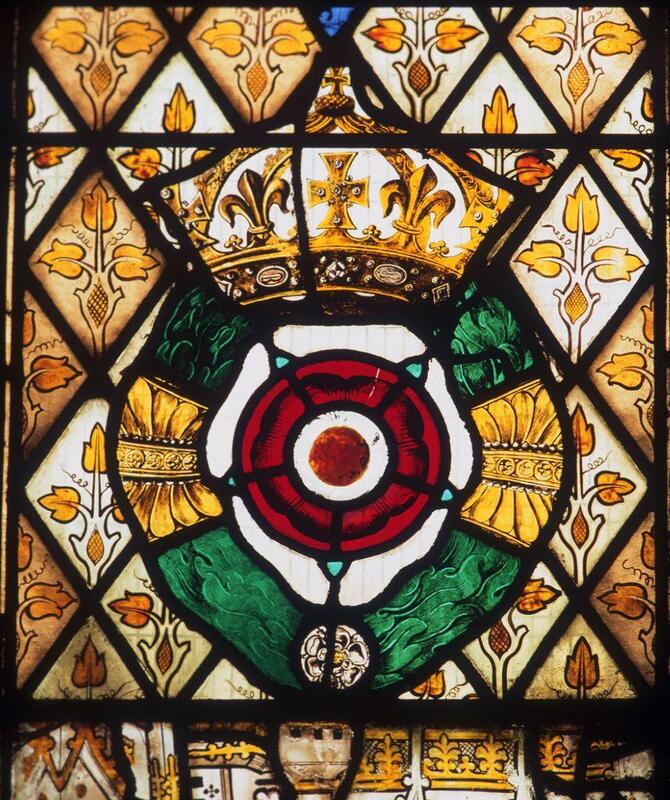
Early Modern England had a complicated relationship with Christianity, its dominant religion, as new beliefs emerged and created a tumultuous time in Christian history. As the popular religion changed, people's beliefs and daily lives changed in response.
After generations of growing tensions, a schism began in 1517 with Martin Luther's launching of the Protestant Reformation. The religious conflicts between the traditional Catholicism and the new Protestantism sweeping the continent eventually made their way across the Channel and English culture was forever altered. Throughout the early 16th century, leading authority figures like King Henry VIII championed a new brand of distinctly English Christianity with the formation of the Anglican Church.
The formation of the Anglican Church was not exclusively spurred on by a change in religious beliefs, however; at this time politics and church were practically inseparable from one another. Religious dogma was not divorced from political agenda and governing figures had a lot to gain from dictating which parts of the Bible were enforced and which were not.
When King Henry VIII’s marriage to Catherine of Aragon was considered a failure due to their lack of an heir, the crown sought an annulment but were refused by Pope Clement VII. The King, desperate for an heir in the politically unstable environment of Tudor England, began the break from the Catholic Church to change the rules regarding at first divorce and soon a myriad of other glaring issues standing in the way of his reign. With a population increasingly disengaged with Catholicism and a government looking to act more freely within the realms of the state’s official religion, England entered a new age of spirituality.
Religious change coincided with technological change, too. The printing press and increased literacy changed the way people were expected to engage in religious texts. Every day, people were now able to independently interpret biblical text and opinions began to differ on how to interpret The Bible. Despite officially all being under one religion, the population began to splinter into opposing sects, sowing the seeds of conflict that would eventually spill blood; religious differences were one of the primary causes of the English Civil Wars of the mid 17th century.
In an era before many scientific discoveries and modern beliefs we now take for granted, religion was often used to explain the unexplainable and guide people through life. Religion dictated their perception of things like mental illness and the "other" with beliefs in witchcraft and demons having sometimes disastrous consequences for everyday people. World events were seen as acts of God and religious dogma controlled what people said or did; or at least it tried to. Rituals changed as the old Catholic ways fell out of favour in England and the way people interacted with Christianity and its symbols and rites underwent tremendous, sometimes violent change.
“And so in this twilight and evening of the world, when sin is flourishing on every side and in every place, when charity is growing cold, the evil of witches and their iniquities superabound.”
Heinrich Kramer, 1486. The Malleus Maleficarum.
The Belief in Witches: From Ambivalence to Violence
Written by F.C.
Popular beliefs regarding witchcraft changed fundamentally between the Medieval and Early Modern periods in England. As a greater focus on policing the public’s beliefs developed because of the Reformation, there was now a general interest in persecuting witches as religious homogeneity became tied to a sense of national security. By the 16th and 17th centuries, England was undergoing a violent cleansing as “witches” were burned, hanged, drowned, or died while having a confession tortured out of them as medieval disinterest in sorcery gave way to nationwide terror. The witch panics that swept English society between this period were the result of a combination of many factors but nonetheless offer incredibly valuable insight into the fears and realities of Early Modern England.
While popular belief around incidents like Salem in 1692 is that witchcraft accusations were largely done out of petty squabbles and for personal gain –and incidents like that did occur– it is important to remember that this was an era of people who fundamentally believed in and were afraid of witches. At such a religiously dogmatic time, the presence of sorcery and Satan were very tangible threats to the daily life of the upstanding English civilian. This was not just a superstition born out of an overzealous population, either, but rather a fairly universal set of beliefs that were held by people from all walks of life, including the upper crust of society.
The late 15th century book Malleus Maleficarum, or, The Hammer of Witches, written by one Heinrich Kramer, heavily influenced the public opinion on witches and was used by authority figures as a sort of reference manual on what to do in the fight against witchcraft. It took the European continent by storm, but it was not long before it influenced English politics and culture too.
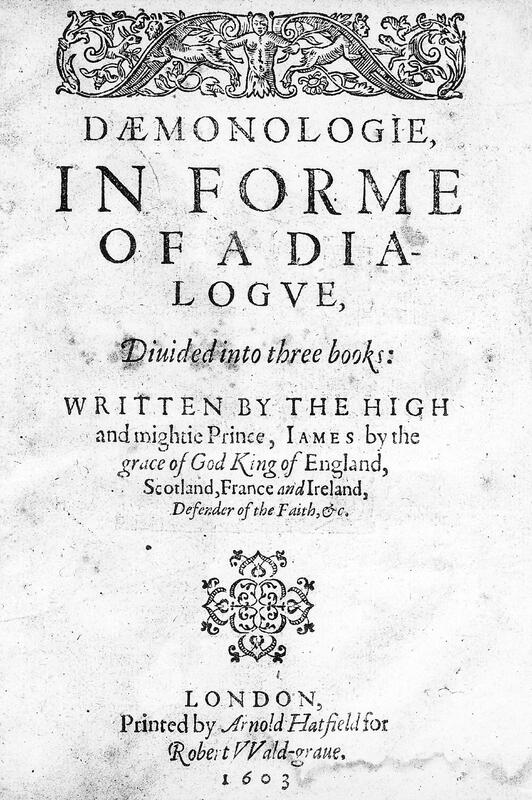
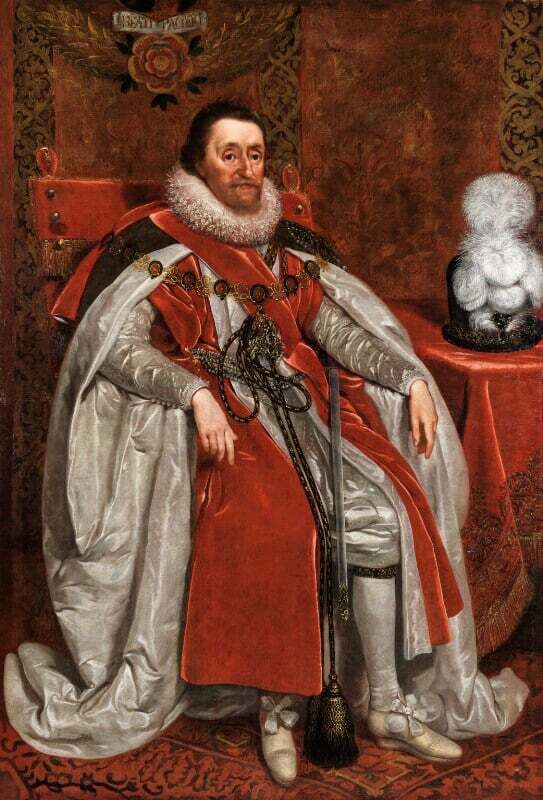
Before he was King James I of England, King James VI of Scotland penned ‘Daemonologie, In Forme of a Dialogue, Divided into Three Books,’ a dissertation calling for the mass persecution of the witches among British society acting out the wills of demons. James was heavily religious and had personal ties to a witch trial just years prior to writing Daemonologie in Scotland in 1590. Daemonologie served as a compendium of demonic entities and their behaviours and the satanic rituals associated with them, a guidebook on how to sniff out suspected witches, and a manual on what to do to them once found. This heavily influential text addressed a newly literate audience as it emphasized a collective responsibility to dismantle Satan’s influence and misactions while structuring it like a dialogue between two imaginary philosophers, simultaneously making it easier to digest and connect it to the credibility of the philosophical texts of the ancient world being rediscovered in Europe.
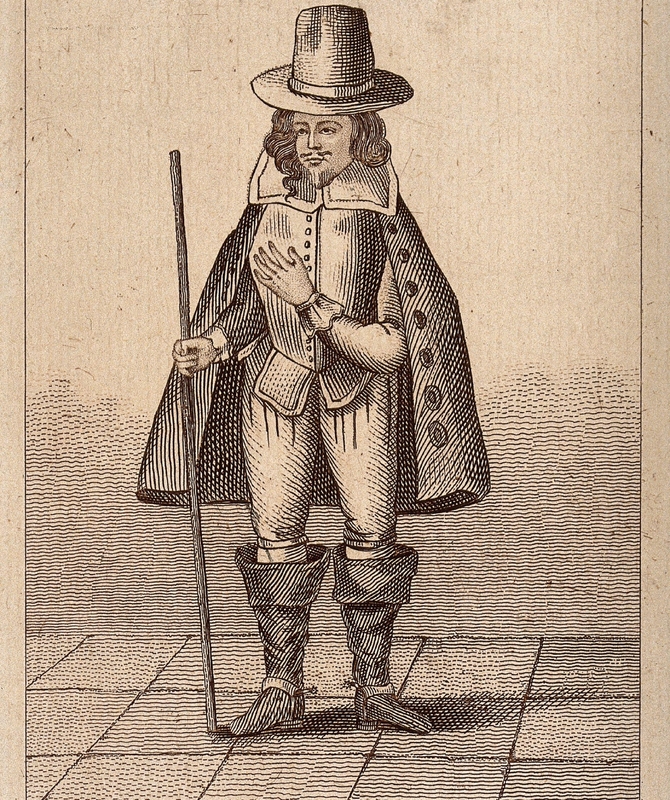
Decades later in the 1640s, before the witch trials began to die down by the end of the century, a particularly catastrophic wave of witch panics occurred in East Anglia under the supervision of Matthew Hopkins, self-appointed ‘Witchfinder General.’ A young man of high birth, Matthew Hopkins became immediately involved in the infamous East Anglian witch hunts after becoming interested in demonological practices and beliefs popular on the European continent. He was not a government official, but his self-appointed title and intense persecution of alleged sorcerers made him and colleague John Stearne formidable figures in the assumed fight against witches.
Matthew Hopkins published ‘The Discovery of Witches’ and went on to get as many as possibly 300 people executed for witchcraft just between the years 1644 and 1647. With figures like these, the public participated willingly in witch hunts even if it meant accusing their neighbours or even families.
It is important to study incidents like this but it is not enough to simply condemn heinous acts like the Witch Hunts; we also have to understand how and why they happened. They may seem absurd to a modern audience but it is vital to understand that the fears and beliefs of a society can always turn into scapegoatism and systemic discrimination or even full executions. We may have stopped believing in sorcery, but we never stopped hunting witches.
Bibliography
Goodare, Julian. “The Framework for Scottish Witch-Hunting in the 1590s.” The Scottish Historical Review 81, no. 212 (2002): 240–50. https://www.jstor.org/stable/25529649.
King James the First. Daemonologie, in Forme of a Dialogue. 1597. The Bodley Head Ltd. and E. P. Dutton & Company. Accessed April 1, 2026, https://archive.org/details/kingjamesfirstdm00jame.
Kramer, Heinrich. The Malleus Maleficarum. Translated by Christopher S. Mackay. Cambridge University Press, 2009. https://ia802901.us.archive.org/23/items/Witcha/The%20Hammer%20of%20Witches.pdf.
O’Brien, Sheilagh Ilona. “The Discovery of Witches: Matthew Hopkins’s Defense of His Witch-Hunting Methods.” Preternature: Critical and Historical Studies on the Preternatural 5, no. 1 (2016): 29–58. https://doi.org/10.5325/preternature.5.1.0029.
Purkiss, Diane. "A Journey into Witchcraft Beliefs.” English Heritage. Accessed April 2026. https://www.english-heritage.org.uk/learn/histories/journey-into-witchcraft-beliefs/.
The Consequences of Government Involvement in Religion and Belief
Written by Morgan Laing
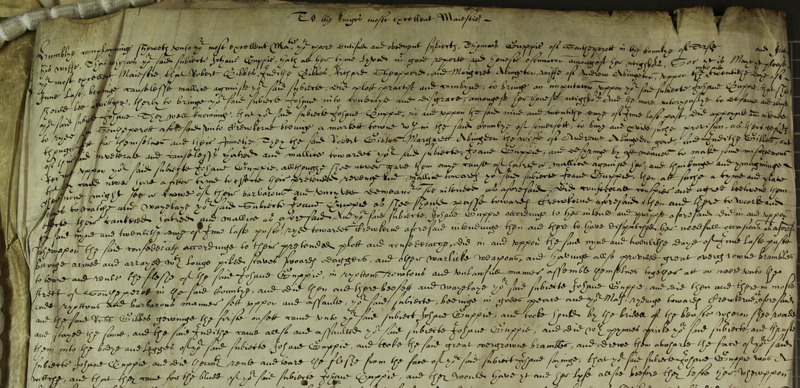
The source above is a Bill sent by one Joane Guippe to the king's royal court in December 1605. Joan’s reason for sending this Bill was to detail an assault that had been carried out on her by members of her community, due to her being accused of witchcraft. She had hoped that the people who assaulted her would be reprimanded and that justice would be carried out. The source unfortunately does not show a response from the court or have any follow-up, so we do not know what came of this whole situation. However, this is not the only primary source where members of the community acted out against people accused of witchcraft. These actions by the community do make sense given that they acted as the main policing body at the time, but what happened to Joan did not really fit that picture. A guilty verdict had not been rendered, and yet these three assailants still attacked her. Usually, the community acted only when there was damning evidence against someone or a genuine reason to apprehend them. One potential reason for these people's actions was the volatile religious climate of the time.
Religious beliefs are an incredibly sensitive area for the majority of people, regardless of the time period. When dealing with a large shift in something so personal to people, it has to be handled properly; there can be dire consequences. What happened to Joan and many other people accused of witchcraft was one of the many examples of these consequences. King Henry VIII and his government had personal reasons for wanting to change to the new Protestant faith. These personal interests motivated the government to directly involve itself in policing what society believed in. This meant that many prior religious practices and most behaviour not considered normal were now legally punishable. Even though the majority of charges did not stand, accusations were still being thrown around frequently and oftentimes simply being accused was enough to ruin someone's life.
In early modern England, judgment from your community meant everything; any fuel that people could use to diminish your character made life actively harder. As with Joan, an accusation that did not stand was enough for her to be nearly killed by members of her community. Reason stands to say that any interaction of an accused person with other people would be much harder for the accused. When living at a time when a person's survival heavily relied on others in their community, being shunned could be life-threatening. The judgment that accused people faced was only made worse by the ruling class’s involvement in trying to change people's beliefs. Lots of subjects wanted to believe in their king, or they found the new way of beliefs to be better on their own merit. Either way, the heavy push for new religious beliefs was the primary reason for the witch trials and the harm that was done to so many people.
Bibliography
Joan Guppie. Bill, December 1605. The National Archives. Accessed April, 13, 2026 https://www.nationalarchives.gov.uk/education/resources/early-modern-witch-trials/accused-by-neighbours/.
Sharpe, James. Witchcraft in Early Modern England. Routledge, 2020.
The Witch Trials in Early Modern England
Written by J.F.
One of the most commonly known events from Early modern England is the witch trials. There are many transcripts of the trials themselves including the confessions of those accused. All the transcripts show how the trials took place and all the information regarding the final result and punishment that individuals faced. Witchcraft alone was viewed as a capital felony and was treated severely and certainly resulted in execution or imprisonment. There were many methods used for the executions of witches some of which include hangings and burning. Today there are many misconceptions about what actually occurred during this time regarding the witch trials. There are many artifacts and documents that have been found that illustrate and show how these trials actually occurred and the process that takes place. Well there are still many misconceptions regarding the witch trials these types of documents aid in clearing how they truly occurred. There are many documents and reports that have been written accurately demonstrating what individuals confess to. The severity of the felony made by the court results in high penalties. Unfortunately due to the severity this left many deceased, due to the high number of false confessions that are believed to occur. Whether the confessions are true or not it does show how relevant these types of accusations influence people.
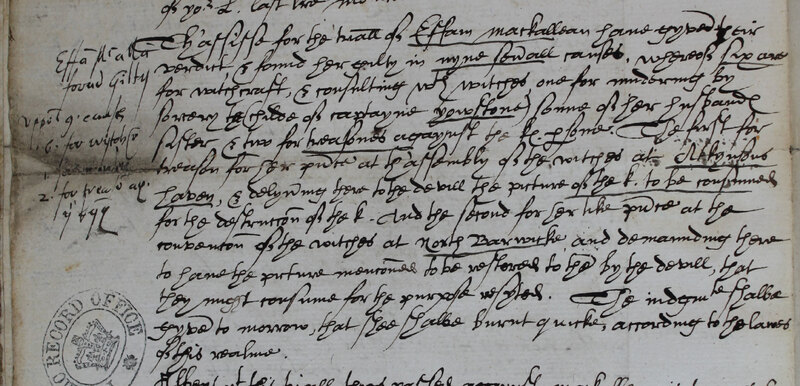
In this source it presents a document written regarding the witch trials that take place in this time period. The documents discuss the account of Effam Mackallean and the trial for which she was accused of treason. Any case of treason at the time was deemed to be a very high offence. She was found guilty on nine counts. Six of the accounts were for involvement in witchcraft and involvement with witches. She was also charged with murder for the death of her husband's sister's son through supernatural causes. Effam was finally charged with treason against the King. Her account of treason was determined by her involvement in witchcraft as well as they claim she was delivering pictures of the King to the devil with the purpose of destroying the King. She was finally charged with the second account of treason for her involvement in a convention of witches having large involvement with the devil. However, it does not say whether she confesses to her crimes in the documents. The idea of witchcraft at this time was feared as it was contrasting the religion and went against the beliefs. The source declares that the final judgment for the trial is that she will be burned to death in a quick manner based upon the laws. The overall source is quite useful as it shows the gravity that accusations such as witchcraft had in this time period and the grave punishments as a result.
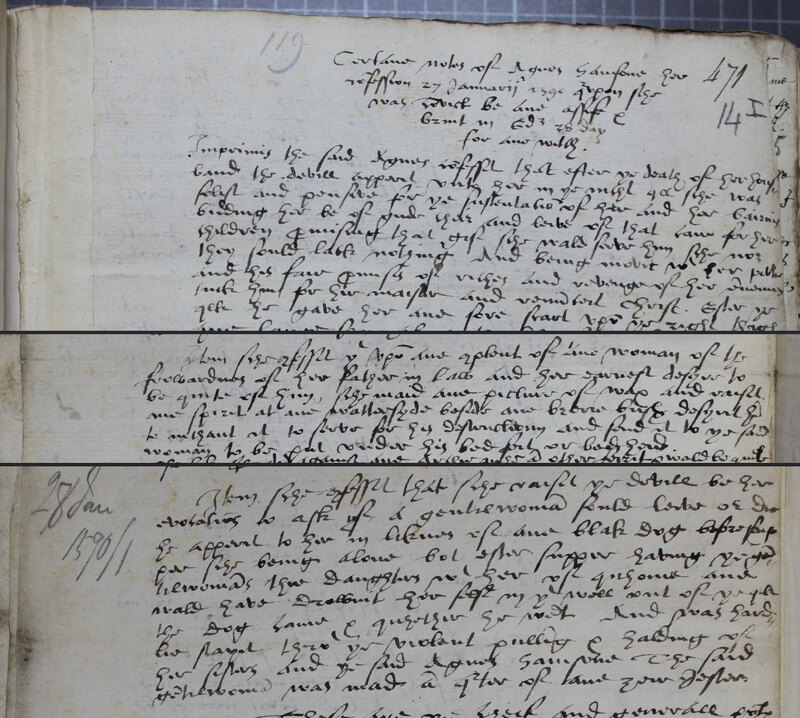
In this source, the old documents shown discuss the witchcraft trials that became popular during this time . In this case a woman Agnes Samson gives a confession for her involvement in witchcraft and her involvement with the devil. The document shows only parts of the three pages of her trial and conviction. The source explains how she admits that the devil had come to her after the passing of her husband. Anges states that the devil made her promises such as keeping her babies well, however only if she made the devil her master and if she renounced Christ. Agnes also makes multiple other confessions such as admitting to helping another woman create a voodoo doll to put a curse on her father-in-law. She claimed to summon a spirit to curse the doll so it would bring harm and death to the father-in-law. At the end of the document it is stated that Agnes had some form of tie to the death or near death experience regarding another woman. During this time there were many false confessions given by individuals due to many circumstances. This source is useful as there are some people who confess to being involved in witchcraft. However there were many that would falsely confess to avoid any means of torture that could come there way if they were to not confess of there involvement. Whether it was due to the mental stress, fear of a rapid execution or their belief of having a good death. In the document it states that she was convicted by the court and burned as her execution.
Bibliography
Amundsen, Karin. “The Duke’s Devil and Doctor Lambe’s Darling: A Case Study of the Male Witches in Early Modern England.” Psi Sigma Siren 2, no. 1 (2004): 28-60. https://oasis.library.unlv.edu/cgi/viewcontent.cgi?article=1004&context=psi_sigma_siren.
"A Witch’s Confession, January 29, 1590." National Archives. Accessed April 9, 2026 https://www.nationalarchives.gov.uk/education/resources/early-modern-witch-trials/a-witchs-confession/.
Lerner, Ross. “Civic Death in Early Modern England.” Medieval Modern Theory 32, no. 4 (2021): 326-345. https://doi.org/10.1080/10412573.2020.1846347.
“Witch Trials in Early Modern Europe and New England.” UC Berkeley School of Law. Accessed April 2026, https://www.law.berkeley.edu/research/the-robbins-collection/exhibitions/witch-trials-in-early-modern-europe-and-new-england/.
"Witches Accused of Treason, June 14 1591." National Archives. Accessed April 9, 2026 https://www.nationalarchives.gov.uk/education/resources/early-modern-witch-trials/witches-accused-of-treason/.
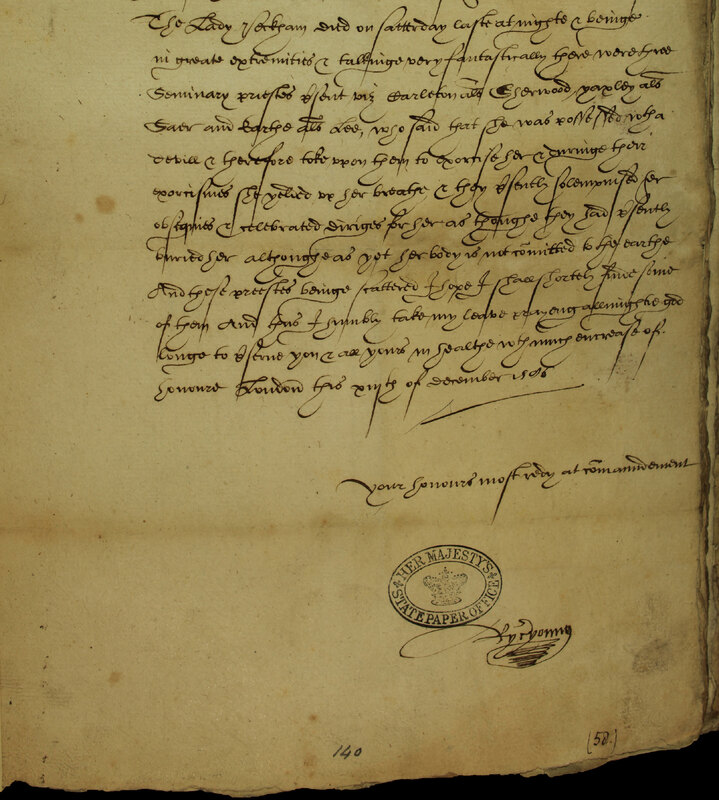
This document is a police record written in the year 1586 that states the tragic death of Lady Peckham. In this document, it provides a brief explanation of her death, blaming the cause of death to be the exorcism that was attempted on her. It goes on to identify the three priest present for the exorcism and the Roman Catholic services they performed on her. As Lady Peckham was an upper class woman in Early Modern England, she had multiple connections to priests who preformed this exorcism on her. This credible source gives us a look into the ideology of the Roman Catholic Church and how they condemned the devil through exorcisms.
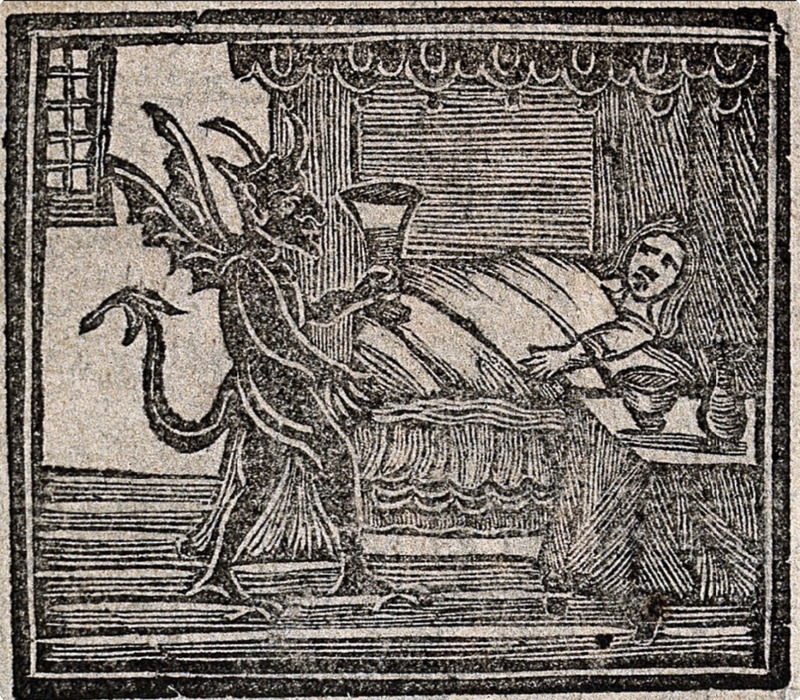
This primary source is a woodcut of a demon feeding a sufferer medicine in a sick bed. This type of artwork was common in Early Modern England, reflecting the widespread fear of the devil and his temptations. In this specific source, it is believed to be a woodcut of a woman named Sarah Bower being visited by the devil as he persuades her to take the medicine he is offering. The purpose behind the woodcut is to warn others of demonic temptations and to create a piece that reinforces religous ideologies and their anxieties. This source is a perfect example of using religous propaganda to contribute to fearmongering in England, therefore making people more suseptible to be controlled.
Bibliography
Report about The Lady Peckham, 1586. National Archives. Accessed January 30, 2026. https://www.nationalarchives.gov.uk/education/resources/early-modern-witch-trials/results-of-an-exorcism/.
Almond, Philip C.. Demonic Possession and Exorcism in Early Modern England : Contemporary Texts and Their Cultural Contexts. Cambridge University Press, 2004. Accessed April, 2026. ProQuest Ebook Central. https://macewan.primo.exlibrisgroup.com/permalink/01MACEWAN_INST/20sb4u/alma991015763343608936.
"The Devil Bringing Medicine To A Man Or Woman In Bed," 1720, Wellcome Collection, Accessed April 9, 2026. https://wellcomecollection.org/works/x6q7x7ca.
Reformation
Written by J.S.
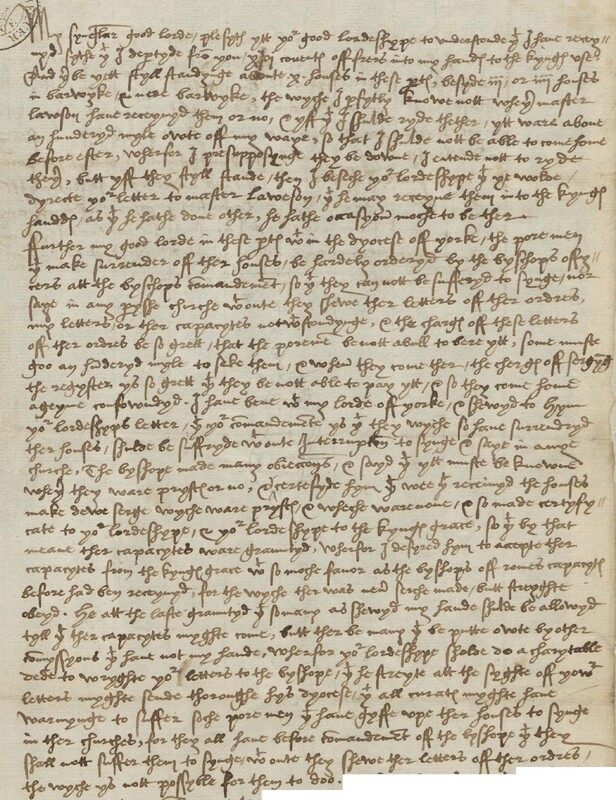
This source is a letter from Robert Ward to Thomas Cromwell. While reading you can immediately tell the author of the letter is quite angry, he seems to believe that what is being done is deeply wrong. The author of the letter is Robert Ward, according to the context attached to the source nothing is known about him other than he was a former friar. The letter is addressed to Thomas Cromwell, he is well known for his massive role in the English reformation being the chief secretary to the king. Ward wrote this letter to Cromwell to try and get him to reform the friars, so they would stop spreading “superstition” to the people. As the author was previously a friar himself, his personal experience is most likely what led him to the conclusion that friars need reformation. While it is hard to tell exactly how it is written, the surface material used to write on appears to be parchment, and was most likely written with a quill as was standard at the time.
The source is written near the beginning of the English reformation, where the church in England was separating from the catholic church. The reforms made were generally not as “radical” as the reforms made during the separate protestant reformation in mainland Europe. The author is clearly biased against the old "superstitious" catholic ways, he was pushing for reform and would probably be in support of the evangelical movement of the time. The source is a piece of a larger letter, however there are no signs that the source is altered in any sort of way. The writer most likely was supportive of the evangelical movement, he was clearly distrustful of the old catholic ways and believed that reforms were necessary.
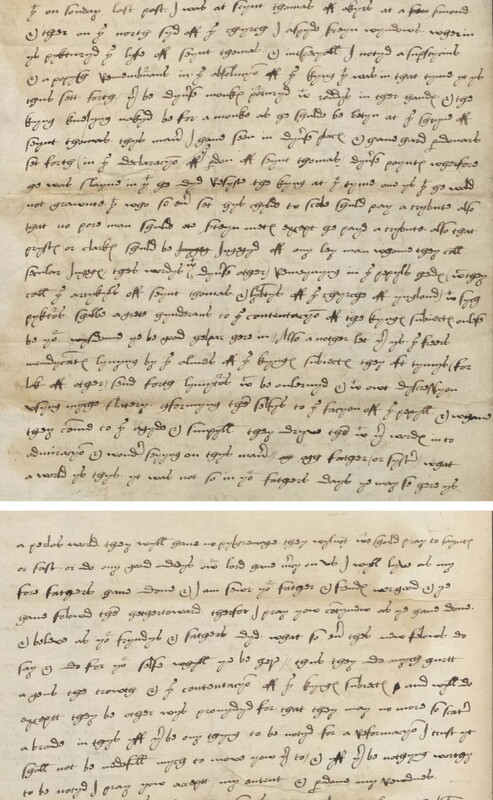
Another letter to Thomas Cromwell shows how after the dissolution of their monastery, monks had great difficulty finding work. Monks would travel long distances in order to find work and were still unsuccessful. This letter displays some of the consequences of the reformation for those who wished to pursue a monastic life.
Bibliography
"Extract from letter from Robert Ward to Thomas Cromwell," 1535. National Archives. Accessed April 9, 2026 https://www.nationalarchives.gov.uk/education/resources/the-english-reformation-c1527-1590/call-to-reform-friars/.
"Letter from Richard Yngworth, [Ingworth], suffragan [assistant] Bishop of Dover, to Thomas Cromwell, his agent," 10 March 1539. National Archives. Accessed April 9, 2026 https://www.nationalarchives.gov.uk/education/resources/the-english-reformation-c1527-1590/problems-for-monks/.