War
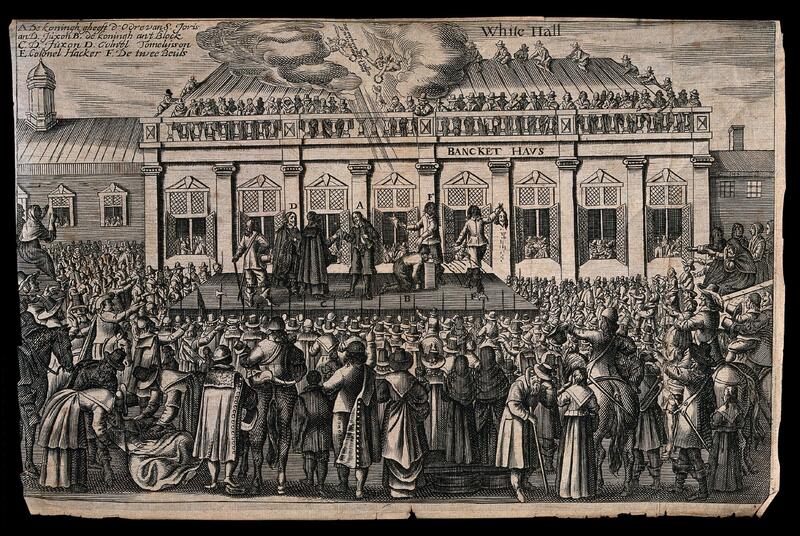
Origins of the English Civil War
Written by Cole Tulloch
This exhibit examines the origins of the English Civil War through the grievances laid out in The Grand Remonstrance (1641) and the Protestant fear of Catholic influence or "popery." The origins of this intense and bloody conflict did not arise out of one single event, but through tensions that had been growing for years over religion, political authority, and the relationship between king and Parliament.
The Grand Remonstrance is especially significant because it captures Parliament's growing belief that the kingdom was being threatened by poor government, corrupt advisors, and attacks on Protestantism, highlighting how these anxieties were not only political but also deeply religious. Fears of "popery" played a major role in shaping how people understood the crisis, which resulted in a further breakdown of trust and made peaceful compromise increasingly unlikely. Overall, the English Civil War emerged from a collapse of trust, as king and Parliament increasingly disagreed over who had the right to govern and protect the kingdom, leading to a bloody conflict that resulted in the beheading of King Charles I in 1649 (seen above).
The Grand Remonstrance (1641)
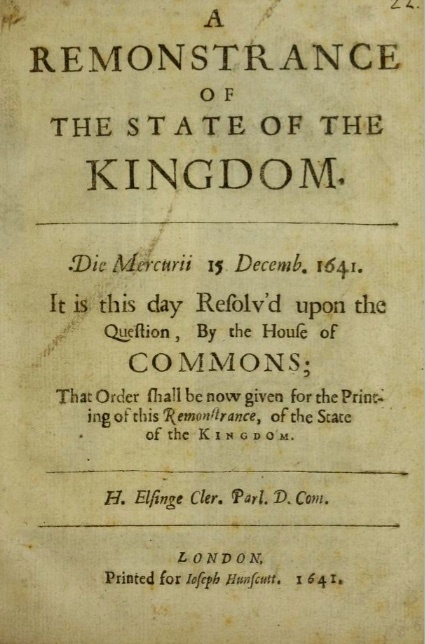
The Grand Remonstrance can be understood as one of the clearest expressions of the growing tensions and breakdown in trust between King Charles I and Parliament leading up to the civil war. This document outlines the multiple grievances held by Parliament, and describes England as being seriously threatened by poor government, corrupt advisors, and religious disorder. The document also presented Parliament as acting in defence of England's laws, religion, and political stability, which is significant to this period because it reflects the growing belief that Parliament had an active role to play in protecting the kingdom.
This is significant in the context of the war's origins because the conflict was not only about disagreements with Charles I, but also about questioning authority and government. Along with this, debates in this period were closely tied to struggles over sovereignty, especially over who had the right to govern in religious matters and who could legitimately protect the kingdom.
This highlights how The Grand Remonstrance shows these grievances had moved beyond an ordinary political dispute, where Parliament increasingly viewed Charles I's rule as something that threatened both the political and religious structures of the kingdom. Additionally, the document highlights how Parliament's loyalty to King Charles I was not unconditional, as their support depended on the king agreeing to cooperation and reforms outlined in the document. Overall, The Grand Remonstrance is an integral document for understanding the origins of the English Civil War because it reveals how political grievance, religious fear, and disputes over authority contributed to increasingly large tensions that made conflict between Charles I and Parliament inevitable.
Fears of "popery" and the Road to Civil War
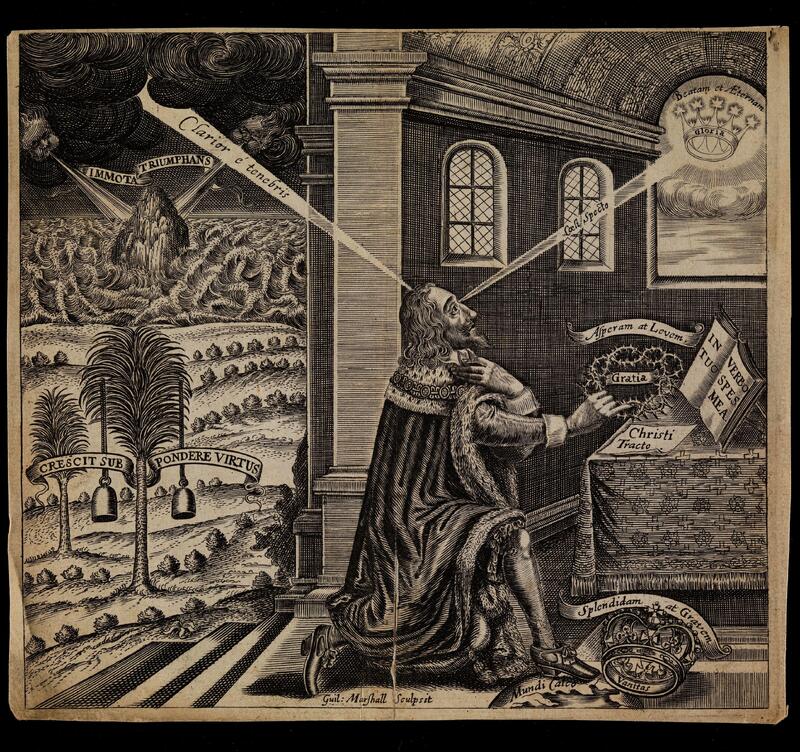
The fear of "popery" was a major part of the rising tensions between Parliament and King Charles I and significantly contributed to the outbreak of the English Civil War. In this period, "popery" was not a term simply used to describe Catholic belief, as it was often used to represent fears of tyranny, corruption, and threats to Protestant England. However, anti-Catholic fear intensified the already growing tensions, especially following the Irish rebellion, which contributed to a growing suspicion that Charles I could not be trusted to defend Protestant interests.
This helps explain why religion is such an important theme within The Grand Remonstrance, where the document presents threats to Protestantism as threats to the stability of the kingdom itself. This shows how anxieties about church government were connected to sovereignty, where fears of Catholic influence were also fears about political power being abused or misused. As a result, fears of "popery" made it easier for Parliament and its supporters to view Charles I's rule as a source of instability and major threat to the religious landscape of England. However, the fear of "popery" did more than reflect religious anxiety, as it furthered both suspicion and breakdowns in trust, and eventually led to the outbreak of civil war.
Conclusion
Overall, this exhibit shows that the origins of the English Civil War were rooted in growing political and religious tensions that had degraded trust and became difficult to resolve. Through the grievances presented in The Grand Remonstrance and the Protestant fears of "popery," it becomes clear that the outbreak of civil war was not caused by a singular issue alone, but by a larger breakdown in trust over religion, government, and authority. Parliament increasingly viewed the kingdom as being threatened by misgovernment, corrupt advisors, and religious disorder, while fears of "popery" made these concerns even more urgent. Together, these tensions pushed the kingdom into conflict, where King Charles I was viewed not as a protector of the kingdom, but as a source of major instability. Because of this, The Grand Remonstrance is a valuable source that shows how England had reached a point where compromise was unattainable, and conflict was inevitable.
Bibliography
"The Grand Remonstrance (December 1641)," In The Commonwealth of England: Documents of the English Civil Wars, the Commonwealth and Protectorate, 1641-1660, edited by C. Blitzer. Putnam. 1963. https://hdl.handle.net/2027/mdp.39015011541490.
Knight, Oliver. "The Grand Remonstrance." The Public Opinion Quarterly 24, no. 1 (1960): 77-84. http://www.jstor.org.ezproxy.macewan.ca/stable/2746667.
Lamont, William. "Richard Baxter, "Popery" and the Origins of the English Civil War." History 87, no. 287 (2002): 336-52. http://www.jstor.org/stable/24425839.
Orr, D. Alan. "Sovereignty, Supremacy and the Origins of the English Civil War." History 87, no. 288 (2002): 474-90. http://www.jstor.org/stable/24427467.
Weaponry
Written by L.B.
Unfortunately, war is an extremely large part of history, with almost every major country on the planet participating in one way or another. This fact continues to hold true when discussing pre-modern England. During this centuries long period, England had participated in numerous conflicts, resulting in many deaths and much destruction. One "good" thing that did come from this series of conflicts was various advancements, some of which are still used today. One of these advancements was the advancements of weaponry. Whether this advancement is considered good or bad is a topic that could be debated, but it is not the focus of this exhibit. This exhibit focuses on and seeks to showcase the evolution of weaponry during the pre-modern era, specifically heavy weaponry and ordnance.
As stated above, war was a large aspect of life in pre-modern England, with major conflicts occurring every few years. More often than not the victors of these conflicts would be those with the better weapons, requiring the defeated to improve their arsenal before fighting once more. This exhibit looks at how these weapons, specifically artillery and cannons, evolved over the centuries-long period of pre-modern England. In order to conduct a proper analysis we must first look at the beginning of our scale, in the 16th century.
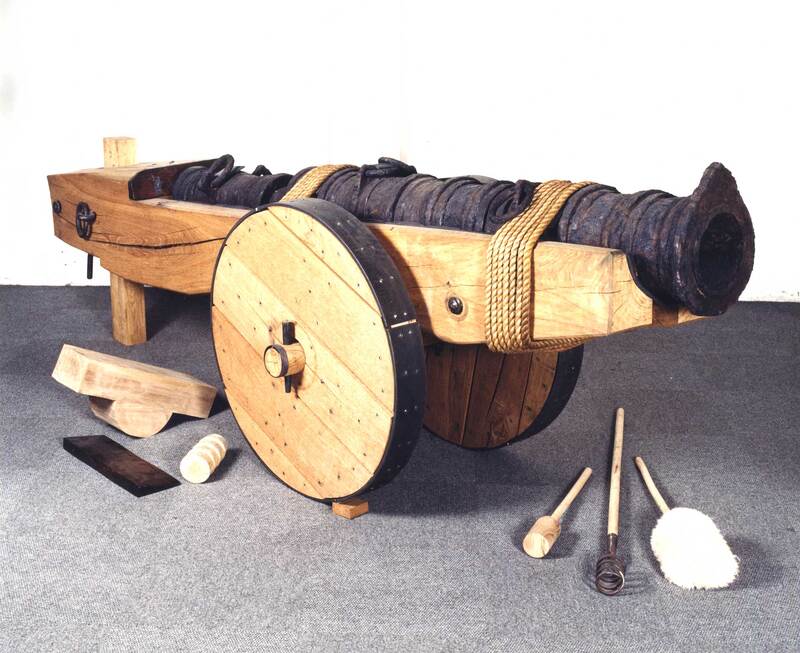
“Henry’s Gun” is a cannon that is currently being hosted by the Hull Museum and Gallery, and will provide us with a baseline of the specification for weapons like this. “Henry’s Gun” is a stave built cannon, which means that the barrel of the cannon is made from multiple sections being joined together by iron staves (metal loops). The cannon is made out of wrought iron allowing for a very durable construct that is highly resistant to stress, though it was quite heavy, making relocation difficult.
There were two types of ammunition used with this piece, cannonballs made out of stone and bags of metal scraps. The stone cannonballs like the cannon were quite heavy, weighing 13 pounds a piece, and were problematic in a number of ways, though the main issue is with the gunpowder required to fire the weapon.
According to Albert Manucy in his book "Artillery through the Ages”, there is no exact calculation for how much gunpowder to use when shooting a cannon, the amount varying between each one due to a number of different variables. Mauncy provides examples of cannons using a one to one ratio or a one to two-thirds ratio, for simplicity's sake we will use the former. Using this method, this means that for the thirteen pound cannonball, thirteen pounds of powder was used, causing the reload time of each shot taking up to five minutes with a group of four men.
The final metric we are using to compare the cannons is the firing distance, which according to the Hull museum the maximum range of “Henry’s Gun” is approximately five hundred meters, about the size of five football fields
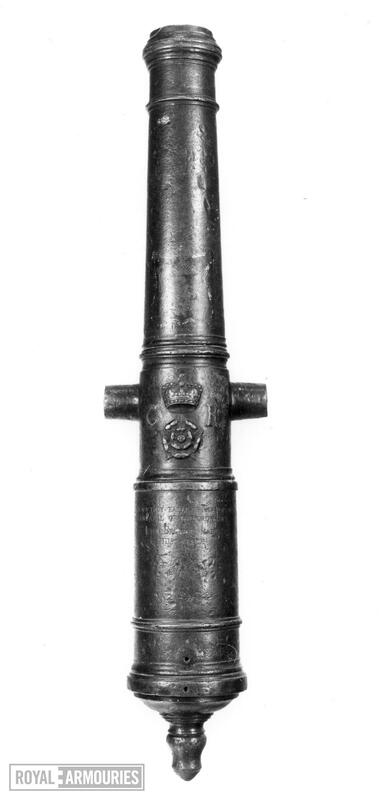
The cannon we will be using to represent the later half of the pre-modern era is a 4-pounder, smooth-bore, muzzle loading cannon. This weapon does not have a nickname, despite being made at the request of Charles I. The cannon is currently hosted by the Royal Armouries Museum in Leeds, UK.
The first difference between the two is that this cannon was cast, rather than stave built. This means that instead of multiple sections being joined together, the entire weapon is made using a mould and molten metal. This allows for larger and more ornate creations, and is also more efficient and cost effective. Moving on, “Henry’s gun” was made of wrought iron while this cannon is made of bronze. Bronze is an alloy, meaning that it was made by melting and combining two different metals, in this case copper and tin. Alloys are used because they are an inherent upgrade to pure metals like iron, having higher strength, durability and corrosive resistance to name a few. This information is listed on the Warner Brother Foundry website.
The ammunition used in this cannon is also different for a number of reasons. First is that this cannon only uses cannonballs and not bags of metal scraps. Second is that the cannonballs themselves are about one-third the size of the ones used by “Henry’s gun”, weighing in at four pounds. The weight of the ammunition is also why this cannon is called a four-pounder.
Using the same metrics as with “Henry’s gun”, the gunpowder needed to fire this weapon will be using a one to one weight ratio with the ammo. This means that only four pounds of gunpowder is needed when firing the weapon, vastly decreasing the time needed in between each shot.
Once again the final metric we are looking at is the firing distance that this weapon is capable of. According to the “Earl of Manchesters” website, the cannon we are looking at is classified as a “minion” due to the weight of the ammo, and the maximum range of the cannon is two thousand yards.
Bibliography
Mauncy, Albert. Artillery Through the Ages: A Short Illustrated History of Cannon, Emphasizing Types Used in America. United States Government Printing Office, 1949. https://dn790000.ca.archive.org/0/items/artillerythrough00ages/artillerythrough00ages.pdf.
"The Difference Between Forged and Cast Iron," APK FerroCast. Accessed April 2026, https://akpferrocast.com/blog/the-difference-between-forged-and-cast-iron/ .
"How to Fire a 17th Century Cannon!" The Earls of Manchester's Regiment of Foote. Accessed April 2026, https://earlofmanchesters.co.uk/how-to-fire-a-17th-century-cannon/.
"Broze Guide: Properties, Characteristics, and Uses," Warner Brothers Foundry Company. Accessed April 2026. https://www.wbcastings.com/blog/bronze-guide/.
"Henry’s Gun, ca. 1500-1540." Hull Museums and Gallery. Accessed April 7, 2026, https://www.hullmuseums.co.uk/homepage/107/henrys-gun-cannon.
"Gun English Bronze 4 - Pounder," 1638. Royal Armouries. Accessed April 7, 2026, https://royalarmouries.org/collection/object/object-37131.